Calvin Symposium on Worship

January 24-26, 2008
Calvin College Institute of Christian Worship

At the 2008 Calvin Symposium on Worship, held January 24–26 in Grand Rapids, Michigan, Dallas explored the relationship between worship, spiritual formation, and everyday life. In these four recordings, he addresses what it means to become more like Christ, emphasizing that genuine spiritual transformation goes beyond religious activity and outward behavior. His teaching invites us to consider how life in God's kingdom can transform every aspect of who we are and how we live.

  1. The Renovation of the Heart: Spirituality 
  2. Worship as the Fine Texture of Real Life
  3. Understanding the Battle Between the Flesh and the Spirit
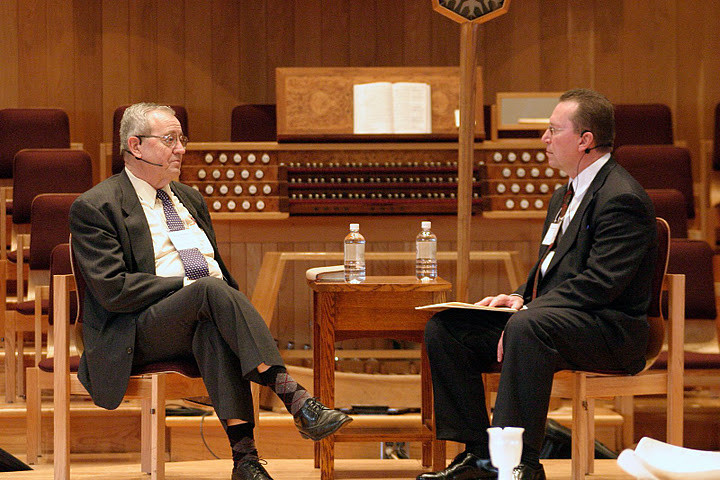
  4. Cornelius Plantinga, Jr. interviewed Dallas about key topics in The Great Omission, The Divine Conspiracy, and Renovation of the Heart.


We extend our special thanks to Calvin University for generously making these recordings available and allowing us to share them with you.

These recordings can also be found in Calvin University's Digital Commons. The program booklet for the conference can be accessed and downloaded here. 

Resources

1: The Renovation of the Heart: Spirituality

What does it mean to become like Christ? Dallas helps us see how genuine spiritual transformation moves beyond forgiveness, religious activity, and trying harder to obey God's commands. He introduces vision, intention, and means as essential elements of spiritual growth, inviting us into a life where loving God and others increasingly becomes the natural expression of who we are in Christ.

2: Plenary Address: Worship as the Fine Texture of Real Life

When Dallas speaks of the fine texture of life in Christ, he is talking about what is written under the lines and between the lines of life, a kind of substructure, that harmonizes and pulls together all of the details of our individual lives here on earth. And each of our lives are lived in very concrete details.


3: Workshop: Understanding the Battle Between the Flesh and the Spirit

The “works of the flesh” (read Gal. 5:19-21) are the natural, inevitable outcome of making human desire supreme in human life.

The “gift” (not human attainment) of the Holy Spirit’s involvement with the regenerate person pursuing holiness is the fruit of the Spirit. (Note: One fruit, many dimensions of character.) 

The resources on this website are freely available here because of the generous gifts of our supporters.

Give
Download & Listen Offline

The Renovation of the Heart: Spirituality

Highlights:

  • Identity and Power: Two fundamental questions of spirituality—Who am I? What can I do?—answered through life in Christ.
  • Transformation rather than Behavior Modification: Becoming the kind of person who naturally loves God and others.
  • Vision, Intention, and Means (VIM): Three essential elements of lasting personal and spiritual transformation.
  • The Gospel of the Kingdom: Moving beyond forgiveness alone into discipleship and transformation through life in God's kingdom.
  • Transformation of the Whole Person: Bringing thoughts, feelings, choices, bodies, and relationships increasingly under the direction of Christ.

Plenary Address: Worship as the Fine Texture of Real Life

Worship is the single most powerful force in completing and sustaining restoration in the whole person. It puts into abeyance every evil tendency in every dimension of the self as long as it prevails. 

What is written under the lines and between the lines of life? What would it look like to have a life in which worship was the prime texture that runs through everything? 
Col 3:17:  "Whatever you do, in word or deed, do all in the name of the Lord Jesus, giving thanks through him, to God, the Father."
– to act in someone’s name is to act for their purposes.

How do we live out Col 3:17?
We learn to abide in constant worship, with our whole being.

What is Worship?
"In worship we engage ourselves with, dwell upon, and express the supreme greatness, beauty and goodness of God – primarily through thought and devotion of our wills, but usually also with the aid of words, rituals and symbols, frequently in union with others." 
— Willard (The Spirit of the Disciplines)

"Worship is admiration to the point of wonder and delight." 
— A.W. Tozer

Worship is something we choose.
God wants you to choose it. Not because He needs it. He's not a cosmic egomaniac. He wants us to worship Him because we need to worship Him. 

What is the role of the worship leader?
A worship leader is someone who is engaged in an admiration of the Trinitarian God to the point of wonder and delight and who is enabled to guide the group into it.

True worship is a great power for goodness in our lives.
"Worship is the single most powerful force in completing and sustaining restoration in the whole person. It puts into abeyance every evil tendency in every dimension of the self as long as it prevails. "— Willard (Renovation of the Heart)

How can we abide in worship, until it becomes the steady, enduring orientation of every aspect of our being?
...by the renewing of our mind, through taking in the Word of God and all of its forms. We are transformed by the renewing of our mind. Our thoughts are fixed on God. We see everything in the light of God. And our feelings are formed according to the greatness of that vision. And when we do that, we incorporate the Word of God into our bodies.

(You can download all of this in the session handout listed under "Additional Assets.")

Workshop: Understanding the Battle Between the Flesh and the Spirit

Greek thought and civilization (such as it was) were stymied on the problem of how to do and bring others to do what they knew to be right. This is a fundamental problem for all who think deeply about life. It is the problem Paul is addressing in speaking about the conflict of the flesh and the spirit in the human being. (Gal. 5:17; cp. Rom. 7:14-24. Also Jer. 17:9) It is the problem of not doing the good that you would sincerely say you intend to do, that you clearly wish you would do, and that you grieve over not having done. It is the problem of “weakness of will” discussed at great lengths in Book VII of Aristotle’s Nicomachean Ethics. Some people take a stronger view and speak of bondage of the will, meaning that we cannot keep from dong what we know to be wrong. Hence the widely used confession that we sin every day in thought, word and deed. Here we want to try to understand the basic nature of the conflict between “flesh” and (the human) spirit, or, as I think we should also put it, between human desire and the human will.

Interview by Cornelius Plantinga, Jr.

Cornelius Plantinga, Jr. interviewed Dallas about key topics in The Great Omission, The Divine Conspiracy, and Renovation of the Heart.