A paper presented at the American Association of Christian Counselors conference,
September 15, 2007
Also available on Kindle
Conference Theme: No Greater Love
Turkish Translation:
Sevgiyi Doğru Anlamak
We praise love, look for it and hope for it, and think of it as a major part of any solution to human problems. We write songs and poems extolling it, and hold conferences with it as the theme: “No Greater Love.” We may think of it as the one thing that can give drama and meaning to our existence or give us the highest level of human performance. But love does not do very well in actuality, in the grimy grind of daily life. Perhaps because of the way it is exalted around us, it proves to be a considerable disappointment to most people and something one can’t really count on. We do not have much confidence in it and are ready to back away from it when it looks like it is not going to “work.” We usually have some “practical alternatives” to love in mind, whatever our situation. This is not only true of people generally, but of professing Christians and Christian groups as well. It is rare to find a church or parachurch staff that is practically oriented around Jesus’ instruction: “Love one another, even as I have loved you” (John 13:34). You might think this would be their primary explicit goal, but it usually turns out otherwise.

It is remarkable how little doctrine relates to love. I read a lot of doctrinal statements by this or that organization. They rarely say anything about love. It would seem that love has nothing essentially to do with doctrine or correct teachings, nor doctrine with love. And one also notes how little is done in practice to help professors of Christianity, even faithful Church members, become genuinely loving persons. We do not, in any effectual way, “make love our aim” (1 Cor. 14:1; cf. 1 Tim. 1:5). And we and the public are constantly confronted with professing Christians who, to say the least, do not love one another, but may clearly hate and despise or be indifferent to those around them. Rarely do you find local congregations or denominational groups that are free of such unloving attitudes. (You surely know of the numerous battles.)
This all stands in glaring contrast to the biblical sources of our faith and practice, and to the lives and testimonies of many of the “Great Ones” in the Way of Christ. Not all of the Great Ones are notable as great lovers, but many are, and they all hold love aloft as the guiding ideal of life. (See St. Francis, Eckhart, William Law and John Wesley, on Christian Perfection in terms of love.) The New Testament writers, certainly, make clear the indispensable centrality of agape love. The apostle John is usually thought of as the apostle of love; and perhaps for many reasons that is appropriate. The passage taken as the standard of this conference is taken from him (1 John 4:7–11). But it is Paul who really helps us to understand the love of which Jesus and the New Testament speak. There is, needless to say, much confusion about love, and what Paul says about it, as well as his practice, can help us to get agape love—and therewith all the other “loves” of the Greek and other languages—right.
The great scholar of the New Testament world and times, Sir William Ramsay, remarked that, “In Paul, for the first time since Aristotle, Greek philosophy made a real step forward.” It sounds strange to our ears to hear Paul put in such company and in such a context. But only if we regard him in this light can we see why and how it was that Paul is the one who, by his teaching and leadership, laid the foundations of what became Western Civilization. We need on some days, at least, to think the thought that Paul—not to mention Jesus himself—was an intellectual as well as a spiritual giant. He and Jesus were at least as intelligent and well-informed about the human self and its activities and processes as Sigmund Freud, Carl Rogers, B. F. Skinner, or whoever your favorite psychologist is. Just honestly read and compare them thoroughly. Paul and Jesus give penetrating analyses of the human being and human processes, and we need to read them as, whatever else, careful analytical thinkers. We need to keep this in mind when contemplating their statements about the core condition of humanity. For example, Jesus’ statement of “the foremost commandment of all” in terms of love (Mark 12:29–31), and Paul’s numerous statements about love as what holds life together and completes it in the Christian’s development.
Among Paul’s statements are:
1 Tim. 1:5—“The goal of our instruction is love from a pure heart and a good conscience and a sincere faith.” Love is what he aimed for in those who heard him.
Rom. 13:8–10—“He who loves his neighbor has fulfilled the law… And if there is any other commandment, it is summed up in this saying, ‘You shall love your neighbor as yourself.’ Love works no evil to a neighbor; love therefore is the fulfillment of the law” (cf. Gal. 5:14). This was how Paul positioned conformity to moral law: not as an objective but as a by-product or side effect of love. And, of course,
1 Cor. 12:31–14:1—especially, “Love is patient, love is kind, and is not envious; love does not brag and is not arrogant, does not act unbecomingly; it does not seek its own, is not provoked, does not keep accounts of wrongs suffered, does not rejoice in unrighteousness, but rejoices in the truth; bears all things, believes all things, hopes all things, endures all things. Love never ceases.”
We should draw from these and similar statements by Paul and Jesus that that love of which they spoke is something (whatever it is, exactly) which arises out of certain prior conditions of the whole self, something which involves an orientation of the whole self toward what is good and right, and something which has amazing, supernatural power for good as it indwells the individual (cf. Col. 1:9–12).
With these guidelines about love in mind, let us attempt a conceptualization of love that would fit it into the Pauline framework. That is, let us try to say, in as plain a way as possible, what agape love is. If we succeed to any significant degree, we shall better understand what we are being told to do when, for example, Paul caps off his instructions on “spiritual formation” to the Colossians by telling them, “beyond all these things put on love, which is the unifying bond of completeness” (3:14), or when Peter caps off his progression of spiritual growth (2 Pet. 1:4–7) by telling us to overlay “brotherly kindness” with agape love. Note that this is something we are to do.
Of course there have been many attempts to get an adequate concept of love, this “many splendored thing.” Thomas Oord, in his Science of Love and elsewhere, defines or describes love as acting intentionally, in sympathetic response to others (including God), to promote overall well-being.1 I believe this to be one of the better efforts toward articulating agape love. Most importantly, it distinguishes love from desire, and locates it in the will, leaving room for desire and feeling to play an appropriate role in love without making them the heart of the matter. Nevertheless, it seems to me that it mislocates love in the ontological structure of the person, and, as a result, cannot really do justice to our three guidelines from Paul. Love, as Paul and the New Testament presents it, is not action—not even action with a special intention—but a source of action. It is a condition out of which actions of a certain type emerge. It is a condition that explains how our three guidelines could be true and must be true.
Let us say instead that love is an overall condition of the embodied, social self poised to promote the goods of human life that are within its range of influence. It is, then, a disposition or character (a second-level potentiality or potency, in Aristotelian terminology): a readiness to act in a certain way under certain conditions. It is not an action, nor a feeling or emotion, nor, indeed, an intention, as “intention” is ordinarily understood—though it gives rise to intentions and to actions of a certain type, and is associated with some “feelings” and resistant to others. It is this understanding of agape love as an overall disposition of the human self that, alone, does justice to the teachings of Jesus and Paul and the New Testament about love and gives us a coherent idea of love that can be aimed at in practice and implemented.
Such love is holistic, not something one turns on or off for this or that person or thing. Its orientation is toward life as a whole. It dwells on good wherever it may be found, and supports it in action. Love is nourished upon the good and the right and the beautiful. That is why Paul the jail-bird writes to his Philippian friends: “Finally, brethren, whatever is true, whatever is honorable, whatever is right, whatever is pure, whatever is loveable and gracious, whatever is attractive, if there is any excellence and if anything worthy of praise, let your mind dwell on these things” (4:8). That, no doubt, was how Paul passed his time in prison. That is how he “learned to be content in whatever circumstances I am” and could “do all things in Him who strengthens me” (vv. 11, 13).
Paul understood the fallacy of those who say “I just can’t love so and so,” and there they stop and give up on love. He knew that they were working at the wrong level. They should not try to love that person but try to become the kind of person who would love them. Only so can the ideal of love pass into a real possibility and practice. Our aim under love is not to be loving to this or that person, or in this or that kind of situation, but to be a person possessed by love as an overall character of life, whatever is or is not going on. The “occasions” are met with from that overall character. I do not come to my enemy and then try to love them, I come to them as a loving person. Love is not a faucet to be turned on or off at will. God himself doesn’t just love me or you, he is love. He is creative will for all that is good. That is his identity, and explains why he loves individuals, even when he is not pleased with them. We are directed by Paul to “be imitators of God, as beloved children; and walk in love, just as Christ also loved you and gave himself up for us” (Eph. 5:1–2). We are called and enabled to love as God loves.
With this understanding of love, as overall disposition to good, in mind, we go back to Paul’s statements:
1 Tim. 1:5—Love arises out of a “pure heart,” of a person not wallowing in fantasies of sensual gratification or malice; a “good conscience,” not burdened with guilt and failure to do the good and the right; and a “sincere faith,” or genuine confidence in God’s goodness and care for us, of his effectual love, from which nothing can separate us (Rom. 8:37–39; 1 John 1:5). We do not achieve the disposition of agape love by direct effort, but by attending to and putting into place the conditions out of which it arises.
Rom. 13:10—The law is directed toward actions conforming to what is good and right. Love too is directed toward the securing of what is good and right, but from the depths of the self from which actions come. If we take care of the sources of action, action will take care of itself. (See the cases of murder and adultery treated by Jesus in Matt. 5:21–30.) We will then not be constantly hindered or defeated in actions by the conflicted self which winds up doing what it “intends” not to do or not doing what it “intends” to do. (Peter’s three denials of Christ, or Paul’s conflicted self of Romans 7.)
1 Cor. 13:4–8—Patience, kindness, humility, etc. arise from the overall disposition of love because it is directed to what is good and right before God and not to the gratification of desires and emotions, except insofar as they are under the governance of the overall disposition of love. Thus it is important to understand that in this passage Paul is not saying that we are to be patient, kind, humble and so forth, but that love itself is patient, kind, humble, etc. That, after all, is what the passage actually says. So we “pursue love” and the rest takes care of itself.
It cannot be said too often that agape love is not desire, and not delight. Desire and feelings generally have a different nature than love, and if we don’t understand this clearly we will remain helpless to enter into love and to receive it into ourselves. Desire and feelings fall into the domain of impulse, not that of choice. They aim at their satisfaction, not at what is better and possibly best. Choice considers alternatives and weighs what is best. If its vision is broad enough, it will find what is good and right. If it is surrendered to God, united with his will, it will be able to do what is best. That of course is the nature of love. It seeks what is best. That is why it enables a person to refrain from hating their enemy, which they might very well want to do, and to seek what is good for them along with all others involved. This certainly does not mean you just give in and do what the enemy (or friend) wants or let them have their way. That might be the worst thing you could do to them.
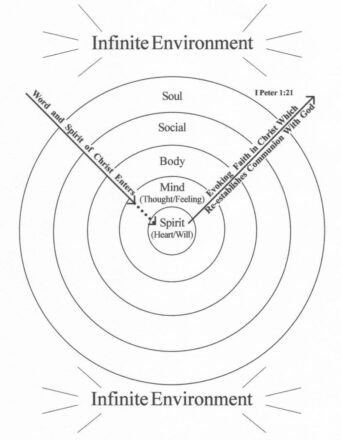
Love, then, is a condition of the will embedded in all fundamental dimensions of the human personality. It is not something you choose to do, but what you choose to be. The will is your capacity to originate things and processes. It is the executive center of the self: the heart or the human spirit. It is meant to direct all dimensions of the self, not by direct and explicit supervision, for the most part, but by indirect means with God. These fundamental dimensions are: the will, of course, the mind (with its thoughts and its feelings, desires and emotions), the body, the social interrelationships, and the soul. That is how Jesus lays out the dimensions of the self and of love in Mark 12:29–31. This first circle diagram puts the dimensions of the self and the sources of action before us. (Diagram from Renovation of the Heart, p. 38.)2
If, now, we want to do the things the scriptures say, we must change the sources of action in the human self. For example, Peter tells us to “put aside all malice and all guile and hypocrisy and envy and all slander” (1 Pet. 2:1; cf. Col. 3:8–9). Understanding something of the condition of love that is required to do this, we look for the sources of malice, etc. in the dimensions of the self and focus our efforts under grace to change them. (Diagram from Renovation of the Heart, p. 40.)3
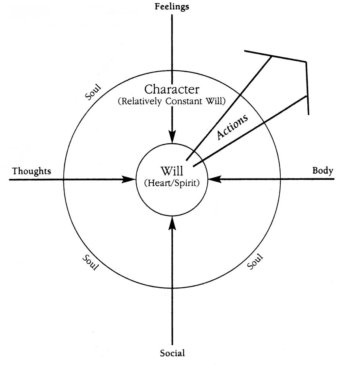
Usually those sources will be located in more than one dimension. But, just to illustrate, malice or desire and intention to harm is often rooted in how we think about the persons concerned: our images of them, the inferences we habitually draw about them, and so forth. Perhaps we see them only as an obstacle to our desires, or as less than “human,” as worthless. Perhaps we need to take steps toward seeing them as objects of God’s love, or as beings of intrinsic value, like our own children or grandchildren or others we delight in. That will, in turn, require changes in how we think about our world and our self. All of this may be helped along by getting to know them, seeing what their life is like, or serving them. Now the question becomes, not just will we love them, drop our malice, but: Are we willing to make those changes in our thinking, willing to allow God to help us do it? (Similarly for feelings, bodily dispositions, social interrelationships, soul conditions.) That is where the will comes into play. It is not the growth of “will power” we are looking for in spiritual formation, but transformation of all dimensions of the self under the direction of God, through a will surrendered to Him and applied appropriately to bring about personal change.
Now that we understand all of this, we can seriously undertake to become persons possessed by love, as love is explained above. Love ceases to be an intimidating and impractical ideal and becomes something we can see progress in day by day, week by week. It is something we can integrate into our doctrine (under standard theological divisions such as Soteriology and Anthropology and Ecclesiology, for example) and organize our practice around in local congregations and beyond. We can undertake actions that remove the barriers to love that reside in the various dimensions of the self. They may reside in the will itself, ultimately the root of all the resistance to love: the will as a stubborn resolve to have one’s own way, to control others, and to be exalted. Such a person will be governed by the desires of the eyes and of the flesh and the pride of life (1 John 2:16). They are quite certainly headed for a life of disappointment and anger, full of attempts at clever manipulation and hypocrisy. To escape such a life they have to surrender self-will as their governing principle, a hardened resolve to have one’s own way. They will have to yield their will to good and to God, and learn to seek what is good for others as well as one’s self. That is what love does. Thus we have the basic spiritual teaching about “death to self.” Jesus tells us that “unless a grain of wheat falls into the earth and dies, it remains by itself alone; but if it dies, it bears much fruit” (John 12:24). A psychologically healthy understanding of what this means is a prerequisite for taking on the holistic disposition which is love.
The will to have one’s own way embeds itself in the other dimensions of the personality and becomes largely “unconscious” to the one governed by it: in habits of feeling, in “automatic” bodily responses, and in thoughtless patterns of social interaction. Self will thus moves outside conscious thought and action and presents itself as simple reality. That objectifies it and presents it as “how the world is.” Love and Jesus’ teachings of love thus seem “unrealistic” or even impossible.
Consider a simple practice and command of Jesus, such as blessing those who curse you, praying for those who mistreat you, and remaining vulnerable to those who have hurt you (Luke 6:28–29). When these are taken out of the range of legalisms and put into the category of natural expressions of the person who lives love, they become things that people can learn to put into practice and find to be all-round much better for themselves and others than the ways of “the world.” It will be necessary to teach the ones involved exactly what these practices are—for example, blessing those who curse you—and why they are good and how they are possible. The bodily habits and social patterns which are shaped to curse when you are cursed and strike when you are struck will have to be reformed by consciously practicing contrary, loving responses until they become habitual. The conditions necessary to such retraining must be put in place and cultivated. We then can develop to the place where, when we are rejected, abused or mistreated, our mind and body responds, not with an automatic “Here is a person to curse, reject and harm,” but with “Here is a person in need of blessings.” To bless them is to explicitly will their good under the invocation of God. You need only think for a moment to see what a difference this would make in families, in public life, in international relations. But we have to learn how to do it.
We have at this point moved to the level of intricate detail that must be gone into to carry though with the understanding of how we come to be persons of agape love. We cannot go further into those details on this occasion, but I hope I have conveyed the basic idea. My concern is to emphasize that once you get it right as to what that love is, you can begin to move into it as a practical and realistic option for living and can lead others into it. Love ceases to be the hopeless task of doing loving things: the things that love, if you had it and it had you, would do. It rests in the love of God for us and casts all care upon him because he cares for us.
That, in turn, means that we, as the people of Jesus and of God now on earth, can teach those who come to him how to live in love. We can bring them toward having, in the language we have used, “an overall condition of the embodied, social self poised to promote the goods of human life that are within the range of its influence.” Such a person will respond favorably to the admonition of John Wesley: “Do all the good you can, by all the means you can, in all the ways you can, in all the places you can, at all the times you can, to all the people you can, as long as you ever can.” (Without right understanding this is just a great weariness.) But they will not be enslaved and ground down by it, for they also do good to themselves, as objects of the love of God. This transformation of disciples of Jesus would be done by systematically leading them through processes that re-form the fundamental dimensions of the self in love of God: heart, soul, mind, and strength. Love of neighbor is the natural result. In this way—the way of cleaning the inside of the cup—we teach them to do all things that Jesus commanded. They do not so much try to do those things, however, as they grow into the kind of person who routinely and easily does them. We do not aim at perfection, but at steady improvement. Perfection will take a little longer, no doubt, and, in any case, is not our aim. We live from the perfection that is in the Trinity.
If the people of Christ on earth take as their aim to fulfill in this way the Great Commission of Matthew 28:18–20, the very best intelligence and techniques of people such as you, Christian Counselors, will be required to help us deal with the intricacies of the processes of growth in love, as they appear in individual cases of all kinds and in many different social and cultural settings. In short, we have to develop a genuinely Christian psychology, and we need multitudes of genuinely Christian psychologists. They will need to be integrated into a genuine Christian Education, and such education made into the substance of what we do “in church.” Then we will see in real life the beauty and power of the love than which there is none greater. There is, indeed, no greater love than this, and within it all of the “loves” of human existence serve their particular goods without destructiveness.
© 2007, Willard Family Trust.
The resources on this website are available to you absolutely free because of the generosity of our supporters. Click the donate button if you'd like to join us in helping people live more fully in the Kingdom of God here and now. All contributions are tax deductible. Thank you!
Thomas Jay Oord, Science of Love: The Wisdom of Well-Being (Philadelphia: Templeton Foundation Press, 2004).
Dallas Willard, Renovation of the Heart: Putting On the Character of Christ (Colorado Springs: NavPress, 2002), 38.
Willard, Renovation of the Heart, 40.
Related Resources