Martin Luther King Jr.:
We must distinguish between his dream and his vision: His dream had to do with what he hoped for the people of this nation and the world, that people would be judged, not on the basis of their differing physical features, but upon the basis of their character. It had to do with his hopes for what men would do: not violence, whether of the kind practiced in the social and political arrangements of a racist (or privileged) society, or the kind practiced in riots which destroyed communities and lives. His dream was that all men should treat others as children of God and members of the same family. His dream was, as he said here in Los Angeles, not burn baby burn, but build baby build, organize baby organize, learn baby learn.
His vision, on the other hand, consisted in nothing that men might or might not do. It rather focused upon what truly is the case about the human condition: about who it really is that is well off, about who it really is that is a good person. It is well expressed in a speech given, I believe, about the mid-point of his career of national leadership, in which he said: “When we are struck we will turn the other cheek, knowing that it is better to go through life with a sordid body than with a sordid soul.” It is also expressed in that stunning sermon which yet today provokes a burning blush of shame from all our multitudinous ways of promoting ourselves and grasping for personal comfort, power, and wealth and glory: when he spoke of the things which he would like to have in his obituary—not the Nobel or other prizes, nor any of the great things he had done, but that he had tried to serve others, had tried to love and help others, had tried to do what was right.
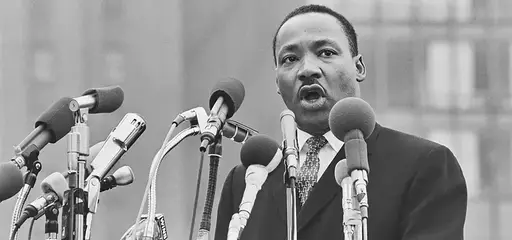
It is this vision that sustained Martin Luther King Jr. in his mission, and laid the only possible foundation of his dream. Many people have the dream, but very few have the vision. They do not believe what he believed about human life. No amount of capital, publicity, cleverness, or man-made credentials and shine can take the place of the vision, and prevent the corruption of the dream through its subservience to the baser outlook of another vision—the nightmare of self-seeking, hedonism, me-to-ism, and claims by the rich and poor alike to rights and justice that boil down to nothing more than me getting what I want. (The so-called “American Dream” is itself a case of a dream that has lost its vision and become the nightmare which we see every day on the so-called “evening news.”)
In his vision, Martin Luther King, Jr. finds his cohorts in Socrates, in Mo Tzu, in the ancient Stoic philosophers1. He finds them in nineteenth century thinkers, such as Thoreau, John Ruskin and Leo Tolstoi. He finds them in that rough-and-tumble German with whom he shared his name. He finds them in Gandhi. But his chief stay was of course in Jesus Christ, for whom he stood as a minister. The most fundamental thing about the message of Jesus is not what it told us to do, but its vision of who is really well off and who is really right. It was from Jesus that he learned: “He that is greatest among you shall be servant of all.” And in his desire to be great in this way lay the strength of Martin Luther King, Jr.
His vision was primarily a vision about what the true values are; about who is really admirable, who is able to lead, and therefore about how the problem of the human race can be solved. It is a tragedy that his vision of the nature of social and political leadership—though hard to deny in the presence of a person such as himself, or others who we have mentioned—is constantly lost, and the reins of leadership so constantly handed to people (perhaps they are the only ones available) who in fact are following the path of self-aggrandizement—though their means be ever so legal. Some of the most pathetic scenes in our recent national life—perhaps in all of our national life—are scenes of people in high social and political position emphasizing that in their admitted path to personal gain and power they have done nothing illegal. It is pathetic that we can even pretend that this alone should be the issue.
The resources on this website are freely available here because of the generous gifts of our supporters.
For more about these Stoic philosophers, see A.B. Bruce, Moral Order of the World in Ancient and Modern Thought, first published in 1899.
Related Resources

Articles

Audio

Video
Articles

Articles
