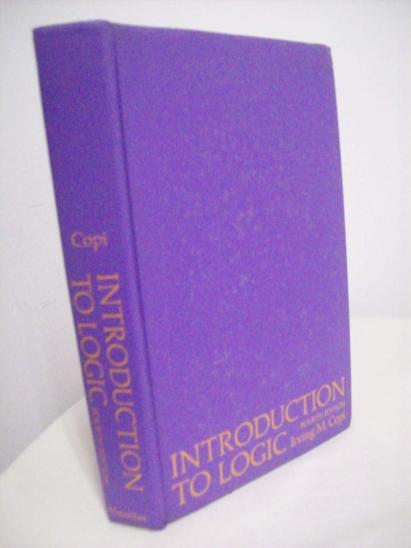
When asked for a beginner's book on logic, Dr. Willard always recommended getting an older edition of this book.
Collier Macmillan Ltd
Easy-to-read and full of real-world applications, this most complete and authoritative book on introductory logic fully prepares users to understand, recognize, and apply classical syllogistic logic and the more powerful techniques of modern symbolic logic--explaining all concepts and techniques clearly, accurately, and thoroughly, and bringing them to life using a wealth of real-life examples of lively arguments and explanations drawn from a wide variety of sources to help demonstrate the application of logical principles by serious writers and thinkers trying to solve real problems in a wide range of fields. Includes full chapters on basic logical concepts, the uses of language, definitions, fallacies, categorical propositions, categorical syllogisms, arguments in ordinary language, symbolic logic, methods of deduction, quantification theory, analogy and probable inference, Mill's Methods of experimental inquiry, science and hypothesis, and probability. Reformulates key logical issues, and presents a more detailed account of the concept of logical equivalence, distinguishing it more clearly from the truth-functional connectives.
Dallas owned the 3rd edition (1968) as well as editions published in 1978 and 1988. He recommended getting the oldest edition possible.
When we asked Dr. Aaron Preston, DWM's Philosopher in Residence, about resources to help teach logic and critical thinking to children and teens, he recommended Peter Kreeft's Socratic Logic, which focuses on classical/Aristotelian logic, and Learning Logic, an illustrated workbook on modern logic designed especially for children by William Lane Craig.
Related Resources


